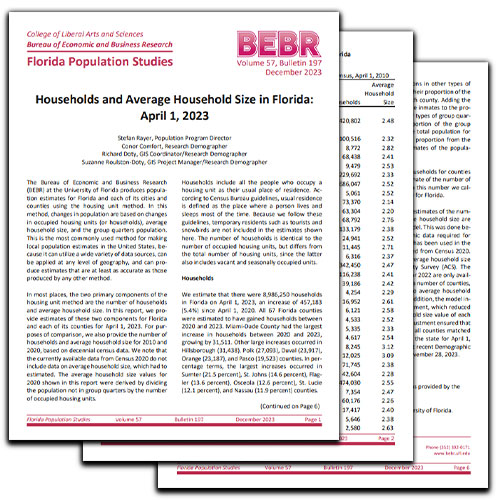
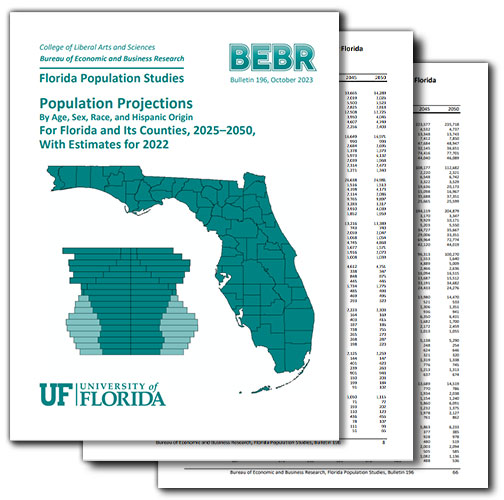
Florida Number of Households and Average Household Size 2023
Download:



As part of a research project at the UF Center for the Humanities and the Public Sphere (CHPS), data was collected about the research interests, collaboration efforts, and classes taught by UF’s Humanities faculty members.
CHPS and the Network Science Program team of the Bureau of Economic & Business Research (BEBR) generated and presented a network profile of shared research topics and co-publications during a meeting of the Social Network Analysis Journal Club at UF’s College of Liberal Arts and Sciences (CLAS).
The insights into the underlying social and topical structure are a profound representation of the research and teaching activities within the humanities field. The results would ideally enable Humanities faculty members to identify and approach groups and individuals for promising future collaborations on shared research topics.
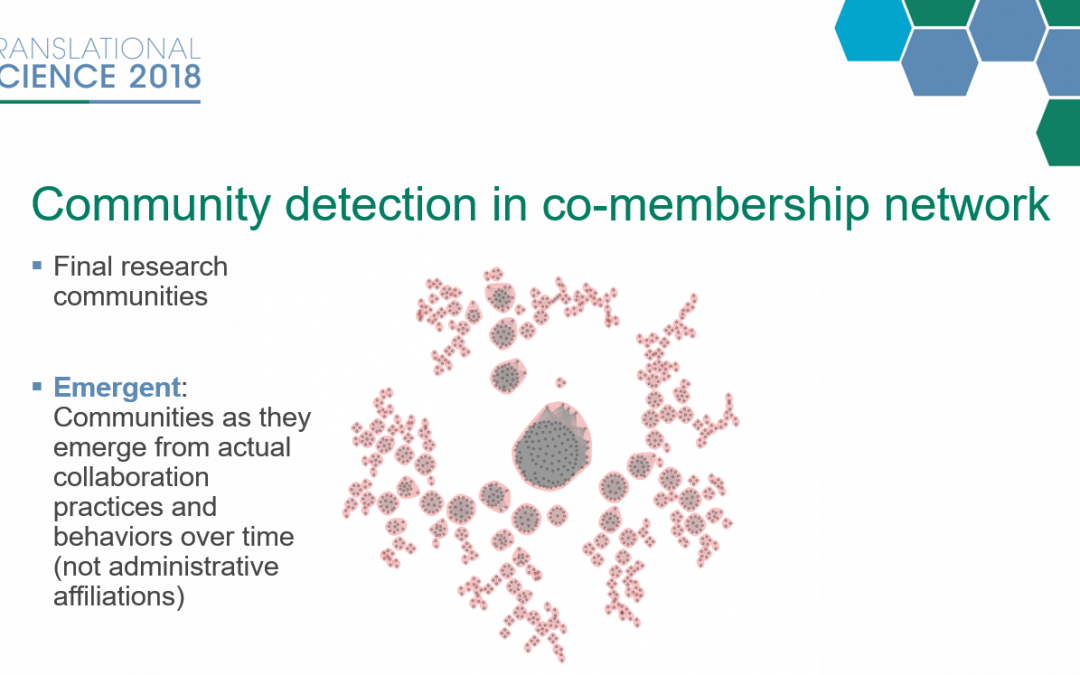

At the 2018 Translational Science Conference, BEBR’s Network Science Program team gave a presentation on their data analysis techniques and intervention strategies. The goal of the Network Science Program team is to expand network science and the inner workings behind “team science” at UF by mapping and analyzing collaboration networks across CTSA hubs and designing network interventions to stimulate collaborative research at UF and across the CTSA consortium. The program’s research is based on collective data from publications, grant proposals, and office space usage, as well as membership in PhD committees.
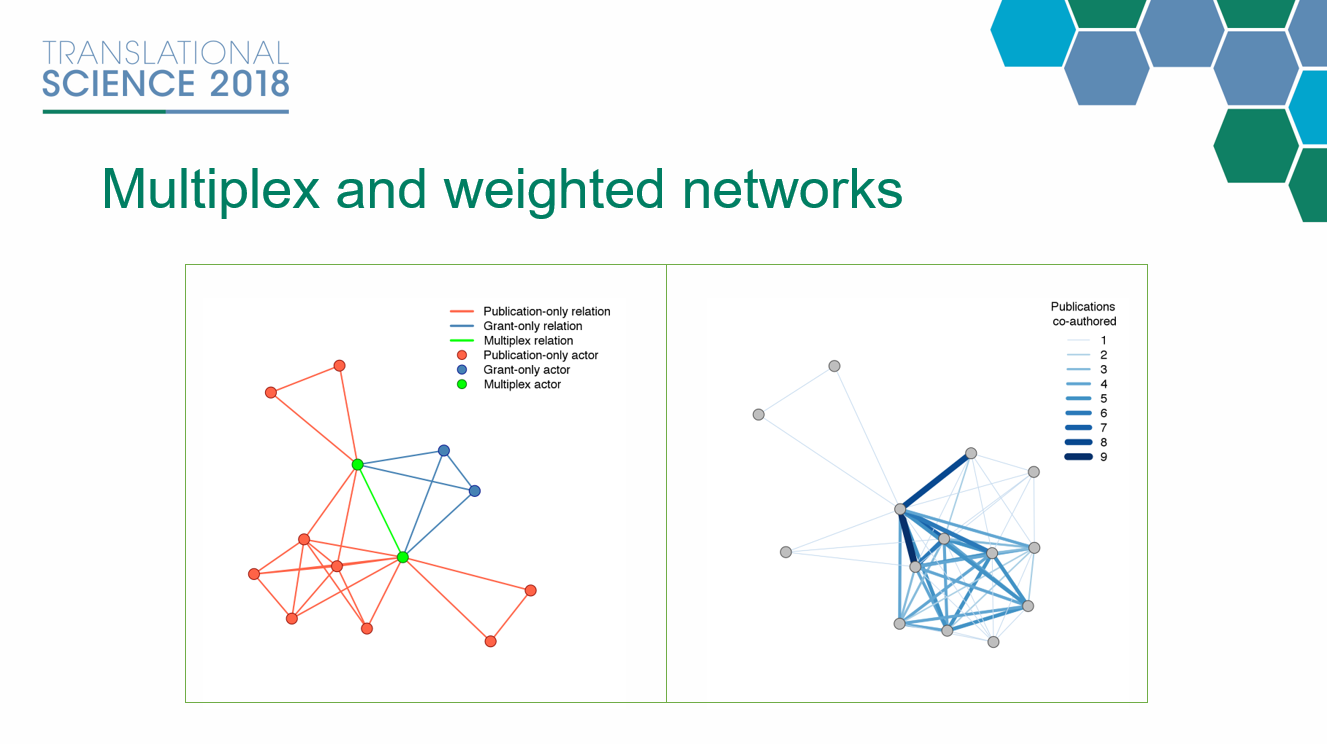
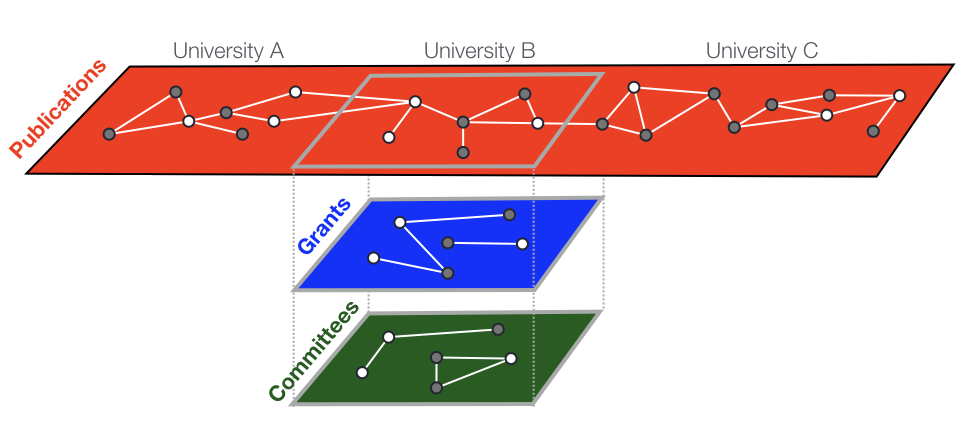
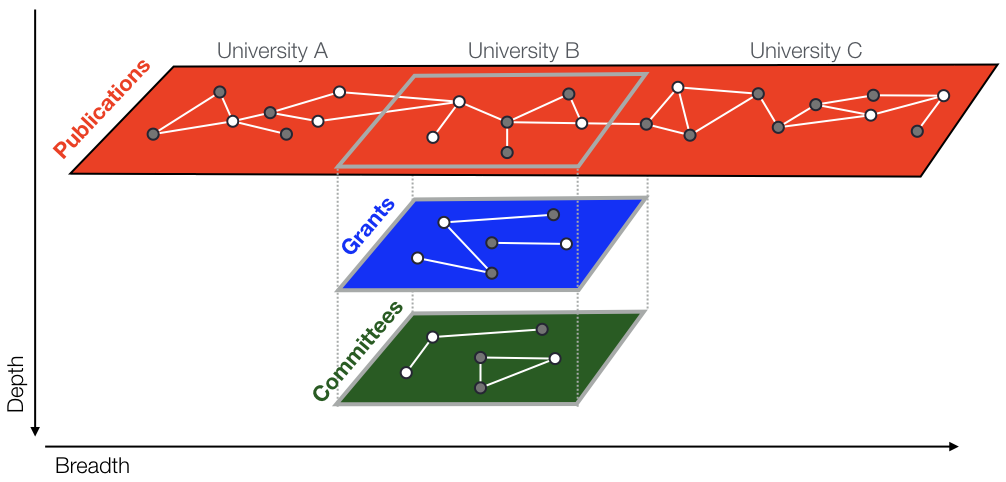
The aim of this paper is to contribute to the understanding of the structural evolution of scientific collaboration networks. A large body of literature has focused on the structure and evolution of co-authorship networks, typically examining networks within a specific discipline, but spanning different academic organizations. By contrast, this paper narrows its focus to a single academic organization (the University of Florida), but expands the network boundary in two ways: including collaborations among scientists in many different disciplines; and examining three dimensions or layers of scientific collaboration, namely, co-authorship on peer-reviewed scientific articles, co-participation in awarded grants, and co-membership in PhD/Master committees.
As a result of collecting data from a five-year window (2011-2015), we obtain a multiplex longitudinal network including three layers (publications, grants, committees). The geometric intricacies of this network are analyzed by looking at the evolution of its global and local properties, in order to shed light on its stochastic formation process, and on the role played by single investigators.
First, we study the network community structure of each layer, and the extent to which community membership is explained by factors such as disciplinary affiliation and workplace location. Results show that intra-department relations are as important as inter-department relations for community formation in the three layers, with department affiliations predicting approximately 50% of the community structure over time. However, we find a high rate of heterogeneity in network communities: publication communities predict respectively 45% and 30% of community memberships in the grant and committee layer. This finding suggests that each dimension of collaboration only partially influences the other, and different mechanisms may drive connectivity in different layers.
First, we study the network community structure of each layer, and the extent to which community membership is explained by factors such as disciplinary affiliation and workplace location. Results show that intra-department relations are as important as inter-department relations for community formation in the three layers, with department affiliations predicting approximately 50% of the community structure over time. However, we find a high rate of heterogeneity in network communities: publication communities predict respectively 45% and 30% of community memberships in the grant and committee layer. This finding suggests that each dimension of collaboration only partially influences the other, and different mechanisms may drive connectivity in different layers.
Second, we test the topological weaknesses of the layers to assess the role of single scholars in connecting different areas of the network. We find that co-authorship and committee network structures are somewhat similar: they appear to gradually converge toward a power-law degree distribution, with a network architecture sustained by interlinked “stars”, which for the co-authorship network is consistent with a small-world model. On the contrary, the grant network shows a core-periphery structure. By testing different breakdown scenarios, we conclude that only the committee layer presents a highly resilient architecture, while network connectivity in the other two layers is strongly dependent on the presence of few hub investigators. This finding has significant implications for academic research policy, suggesting that academic research networks would benefit from a system of incentives for highly-connected scholars to i) remain in the university maintaining an efficient network of collaborations; and ii) increase the involvement of their collaborators in research projects, in order to reduce the dependency of the overall network from their own work. A number of inferential tests and heuristic methodologies are implemented to assess the robustness of our findings.

