Uncategorized
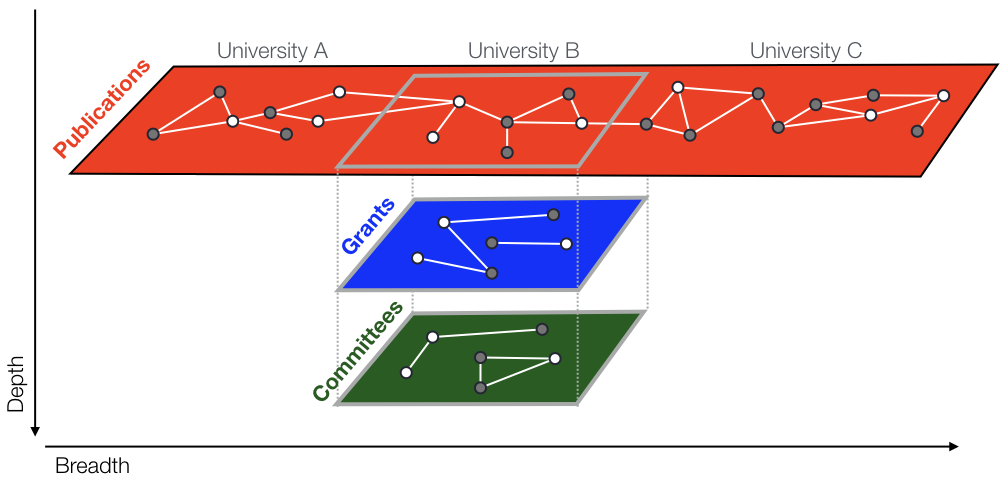 The aim of this paper is to contribute to the understanding of the structural evolution of scientific collaboration networks. A large body of literature has focused on the structure and evolution of co-authorship networks, typically examining networks within a specific discipline, but spanning different academic organizations. By contrast, this paper narrows its focus to a single academic organization (the University of Florida), but expands the network boundary in two ways: including collaborations among scientists in many different disciplines; and examining three dimensions or layers of scientific collaboration, namely, co-authorship on peer-reviewed scientific articles, co-participation in awarded grants, and co-membership in PhD/Master committees.
As a result of collecting data from a five-year window (2011-2015), we obtain a multiplex longitudinal network including three layers (publications, grants, committees). The geometric intricacies of this network are analyzed by looking at the evolution of its global and local properties, in order to shed light on its stochastic formation process, and on the role played by single investigators.
First, we study the network community structure of each layer, and the extent to which community membership is explained by factors such as disciplinary affiliation and workplace location. Results show that intra-department relations are as important as inter-department relations for community formation in the three layers, with department affiliations predicting approximately 50% of the community structure over time. However, we find a high rate of heterogeneity in network communities: publication communities predict respectively 45% and 30% of community memberships in the grant and committee layer. This finding suggests that each dimension of collaboration only partially influences the other, and different mechanisms may drive connectivity in different layers.
First, we study the network community structure of each layer, and the extent to which community membership is explained by factors such as disciplinary affiliation and workplace location. Results show that intra-department relations are as important as inter-department relations for community formation in the three layers, with department affiliations predicting approximately 50% of the community structure over time. However, we find a high rate of heterogeneity in network communities: publication communities predict respectively 45% and 30% of community memberships in the grant and committee layer. This finding suggests that each dimension of collaboration only partially influences the other, and different mechanisms may drive connectivity in different layers.
Second, we test the topological weaknesses of the layers to assess the role of single scholars in connecting different areas of the network. We find that co-authorship and committee network structures are somewhat similar: they appear to gradually converge toward a power-law degree distribution, with a network architecture sustained by interlinked “stars”, which for the co-authorship network is consistent with a small-world model. On the contrary, the grant network shows a core-periphery structure. By testing different breakdown scenarios, we conclude that only the committee layer presents a highly resilient architecture, while network connectivity in the other two layers is strongly dependent on the presence of few hub investigators. This finding has significant implications for academic research policy, suggesting that academic research networks would benefit from a system of incentives for highly-connected scholars to i) remain in the university maintaining an efficient network of collaborations; and ii) increase the involvement of their collaborators in research projects, in order to reduce the dependency of the overall network from their own work. A number of inferential tests and heuristic methodologies are implemented to assess the robustness of our findings.
Download the PDF here
Uncategorized
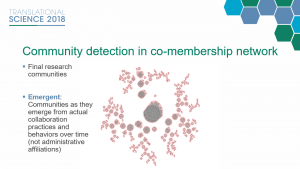
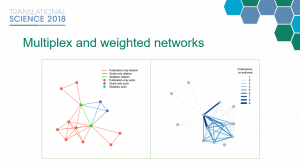
Members of the Network Science Program at BEBR gave a presentation at the Translational Science 2018 conference on their data analysis and intervention strategies. The program aims to expand network science and science of team science at UF, map and analyze collaboration networks across CTSA hubs and design network interventions to stimulate collaborative research at UF and across the CTSA consortium. The research of the program is based on publication, grant proposal, and office space data, as well as membership in PhD committees.
Uncategorized
 As part of a research project at the Center for the Humanities and the Public Sphere, data on the research interests, collaboration and topics of classes taught by the UF Humanities faculty members was collected. In a joint effort with the Network Science Program team at BEBR, a network profile of shared research topics and co-publications was generated and presented during a meeting of the Social Network Analysis Journal Club at the College of Liberal Arts and Sciences. The insights into the underlying social and topical structure are a profound representation of the research and teaching activities within the Humanities, which enable these faculty members to identify and approach groups and individuals for promising future collaborations on shared or neighboring research topics.
Economic Analysis Projects
Hector H. Sandoval, Anita Walsh, Mark Girson
March 2019
The elderly population in Florida has significantly increased, therefore, as a result, long‐term care needs have also expanded, and a majority of senior Floridians are receiving home healthcare, living in nursing homes, or residing in assisted living facilities (ALFs). While the geriatric population receiving these services has increased, the overall cost and challenges faced by the healthcare providers has skyrocketed. For this project, the University of Florida Bureau of Economic & Business Research (BEBR), commissioned by the Florida Assisted Living Association (FALA), developed, and administered an online survey to assess these eldercare challenges. As a follow-up to the online survey, a telephone survey was conducted to gather more information about Floridians’ financial preparation for residing in an ALF.
Economic Analysis Projects
Hector H. Sandoval
November 2018
Founded in 2008, University of Florida Clinical and Translational Science Institute (UF CTSI) is the academic hub for clinical and translational science throughout the University and the State of Florida. The mission of UF’s CTSI is to improve human health by strengthening the University’s ability to conduct clinical and translational research.
Over one thousand researchers are associated with the CTSI and benefit from its services and resources. This project investigates individual research records on external funding, the number and quality of publications, and follows a quasi-experimental approach to estimate the effects of CTSI’s association on research productivity. Additionally, the project analyzes the expenditures of CTSI along with the associated increase in external funding attracted by CTSI researchers, which contributes to the regional economy of Alachua County and the State of Florida through the creation of jobs, purchases of products / services from local industries, and corresponding household spending.
Economic Analysis Projects
Hector H. Sandoval, Anita Walsh
September 2018
This project investigated how Florida’s retirees contribute about $184 less per person (about 2 percent less) to State and local government revenues compared to Florida’s non-retiree adult population. Florida’s governmental expenses are $3,985 less per person (about 35.1 percent lower). Comparatively, these contributions and expenses result in a positive net fiscal impact of $2,899 per retiree on Florida’s overall budget. In contrast with non-retiree adults in Florida, generally, retirees earn slightly less income and spend a smaller portion of that limited income on taxable goods. As a result, Florida’s retirees contribute around 12.5 percent less per person to gross receipt tax revenue and 3.9 percent less per person to all other revenue sources. Alternatively, Florida’s retirees tend to own more valuable homes, and as a result, they contribute about 22 percent more in property tax revenue.
Economic Analysis Projects
Hector H. Sandoval
January 2018
- Prepared by the University of Florida Bureau of Economic and Business Research (BEBR)
- Hector H. Sandoval, PhD, Bureau of Economic and Business Research
Racial inequity is a long-standing issue in many communities across the United States, affecting the opportunities of minority individuals and families. In March 2016, the United Church of Gainesville and the Alachua County branch of the National Association for the Advancement of Colored People (NAACP) sponsored a weekend-long seminar to focus community efforts on inequities in the Alachua County area. The seminar featured speakers from the Dane County, Wisconsin Race to Equity Project. This project collected existing national, state, and local data documenting racial disparities in the county and comparing those disparities to Wisconsin and the United States overall. Their study led to a community-wide focus on how their community can work together to meet the challenge of narrowing the gaps in quality of life among all racial and ethnic groups.
A group of Gainesville, Florida community leaders representing Alachua County, Alachua County Public Schools, City of Gainesville, Gainesville Area Chamber of Commerce, Santa Fe College, UF Health, and University of Florida saw value in completing a similar project. Wishing to understand and document racial inequity in Alachua County, this group called for the development of a baseline report grounded in quantitative findings to document and provide insights about the extent, nature, and source of racial inequality in Alachua County. The University of Florida Bureau of Economic and Business Research (BEBR) led this project in collaboration with the University of Florida Program for Resource Efficient Communities (PREC). This website contains the main results of this effort.
Please let us know how you are using the information contained in this report by emailing United Way of North Central Florida at research@unitedwayncfl.org.
Use the following links to download the documents containing the baseline report, the more in-depth supplemental module on housing, transportation, and neighborhoods developed by UF PREC, and a slide show presentation of the report.
BASELINE REPORT:
HOUSING, TRANSPORTATION, and NEIGHBORHOOD BASELINES:
PRESENTATION (SLIDES):
Economic Analysis Projects
Hector H. Sandoval, Camila Garcia
December 2016
Cox Communications is a broadband communications and entertainment company that operates six clustered cable systems in 18 states, providing advanced digital video, Internet, telephone and home security and automation services over its own nationwide IP network. In Florida, Cox Communications provides information services in two different regions, Central Florida and Gulf Coast. This project showed that while Cox Communications provides its services, it also contributes to both regions’ economies through the creation of direct and indirect jobs, overall earnings, and through purchases generated by the company’s business activities.
Economic Analysis Projects
Hector H. Sandoval, Steven Rowe, Anita Walsh, Colleen K. Porter
June 2016
Florida’s Indigent Health Care program in Polk County ensures quality healthcare for its low-income residents. The program’s funding stems from its voter-approved one-half cent sales surtax, an initiative that has enabled the provision of medical and dental services to individuals in need for over a decade.
This report was conducted by the University of Florida’s Bureau of Economic and Business Research to study the far-reaching impacts of the Indigent Health Care program.
The research results paint a compelling picture:
• To sustain the Indigent Health Care program’s current level of operations, Polk County’s direct property tax rate would need to be increased an estimated 1.3391 mils, reinforcing the vital role of the one-half cent sales surtax.
• The Indigent Health Care program is a cornerstone in the Florida’s healthcare rankings. Without the program, Polk County’s rank would decrease, which leaves a large portion of its county population without coverage.
• Beyond providing healthcare, the program itself has increased local economic growth with about 177 jobs directly linked to its existence.
• Polk County residents have readily available access to regular primary healthcare, which, in turn, reduces emergency room congestion and increases the rate of preventable hospitalizations.
• The availability of local licensed primary care physicians has increased, which contributes to the improvement of overall health outcomes.