Florida Estimates of Population 2024
Download:

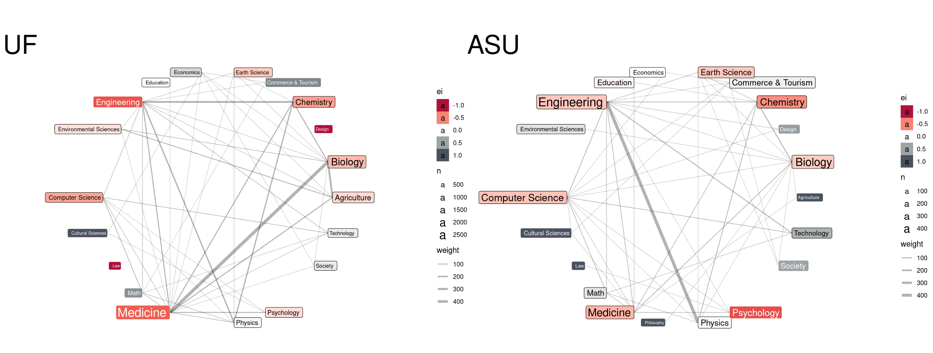
In November of 2021 at Arizona State University (ASU), network scientists presented the results of a study comparing researcher collaborations at University of Florida (UF) and ASU. The study used information on collaboration between scientists at the two universities over 20 years to compare the way collaborations changed at UF as compared to the way they changed at ASU. While both ASU and UF are growing in size and interdisciplinarity, comparisons between ASU and UF are difficult due to the differences in size and disciplinary focus. Click here to view the presentation.


As part of a research project at the UF Center for the Humanities and the Public Sphere (CHPS), data was collected about the research interests, collaboration efforts, and classes taught by UF’s Humanities faculty members.
CHPS and the Network Science Program team of the Bureau of Economic & Business Research (BEBR) generated and presented a network profile of shared research topics and co-publications during a meeting of the Social Network Analysis Journal Club at UF’s College of Liberal Arts and Sciences (CLAS).
The insights into the underlying social and topical structure are a profound representation of the research and teaching activities within the humanities field. The results would ideally enable Humanities faculty members to identify and approach groups and individuals for promising future collaborations on shared research topics.

